
March Madness Recap: Mental Health Edition

March Madness came to a close at the beginning of April, and it was a whirlwind as always. Brackets were busted, underdogs climbed the ranks, and there was buzzer-beater excitement on the court. The teams that emerged victorious included the Michigan Wolverines for the men’s tournament and the UCLA Bruins for the women’s.
Along with the typical chaos and thrills, there was also an undercurrent of something more—something bigger than the game; athletes speaking up and sharing about their mental health journeys on and off the court.
Collegiate athletes can be perceived as one of the healthiest populations out there. On the outside, they often seem like they have it all: the youth to bounce back from tough training, the experience of a decade plus of sport specialization, elite coaching, scholarships, and sometimes even compensation, with Name, Image and Likeness (NIL) deals becoming more and more prominent.
But on the inside, they are feeling the weight of internal and external expectations in training and competitions, the demands of classes and homework, complex schedule management, possible injuries, athletic identity struggles, body image issues, balancing a social life, physical fatigue, and sometimes even burnout.
Despite these exorbitant demands, many athletes manage this internally, without support, due to the stigma surrounding mental health in athletics. On top of it all, athletes are acutely aware of the public perception (and expectation) for them to be superhuman, and the real impacts this struggle has on their career opportunities in and out of sport.
The number of NCAA athletes who have died by suicide in the past 20 years between 2002-2022 has doubled (Whelan et al., 2024). Suicide is the third leading cause of death in student athletes aged 15-24. The efficacy of the “tough it out” and “suck it up” mindset that has been sustained in sports culture is now frowned upon by sports psychology experts and is even viewed as dangerous to the modern day athlete. These stats go to show that despite being surrounded by a team every day, athletes are still feeling isolated, alone and dysfunctional if they can’t be “strong” all the time.
But this year's March Madness champions are telling a different story. They not only won the biggest title in college hoops, but have also proudly shared their mental health struggles and journeys. They are challenging the outdated idea that athletes don’t struggle—we are all humans at the end of the day!
Pennsauken, New Jersey native Yaxel Lendeborg, along with the rest of the Michigan Wolverines, have modeled a supportive community within their team—leaning on one another for help and support and having the intentionality and emotional resources to provide it.

On the women’s side, Most Outstanding Player and consistent therapy-goer Lauren Betts embodies elite performance while managing mental illness; all while in contention for UCLA’s first national title.

These athletes are using their platform to validate and normalize mental health struggles on the big screen. This has widespread impacts for the millions of fans and athletes watching. They highlight that athletes don’t have to keep it all inside, they are not less-than for having a tough time, and asking for and receiving help is actually a part of the mindset of the champions.
No “I” In Team
How Yaxel Lendeborg’s openness led to team support in his time of need.
Heading into the locker room at half time, Big Ten All Star player Yaxel told a courtside reporter, “I feel awful, I feel super weak,” after playing through the full first half with no substitutions or breaks, all while managing knee and ankle injuries. Playing an entire half for any individual is exhausting, but to hear an athlete admit this in real time is a moment of vulnerability we don’t often see; getting a peek underneath the superhuman mask elite athletes tend to don.

As a clinical therapist, I do not condone playing through injuries, no matter the stakes. As an athlete, I get it. Final year of eligibility, championship game, of course Yaxel is going to be adamant about playing despite the potential risks. With all that said, Yaxel was struggling mentally and physically throughout the first half. He air-balled open shots, missed defensive plays, and was showing open frustration at his performance.
Yaxel had every right to feel dejected, frustrated and exhausted. Under the pressure to make his final collegiate game the best he could, he may have started spiraling—beginning to wonder if he was holding his team back or disappointing his coaches and teammates. Instead of pushing this emotional experience down, Yaxel exhibited vulnerability through verbalizing his struggles and allowing his teammates to show up for him.
His friends rallied around him, offering encouragement, humor, and reminders of the talent and hard work he’d put in to get them into the championship game. Through their support, Yaxel was able to get back into the present moment and grounded in his confidence as an athlete.
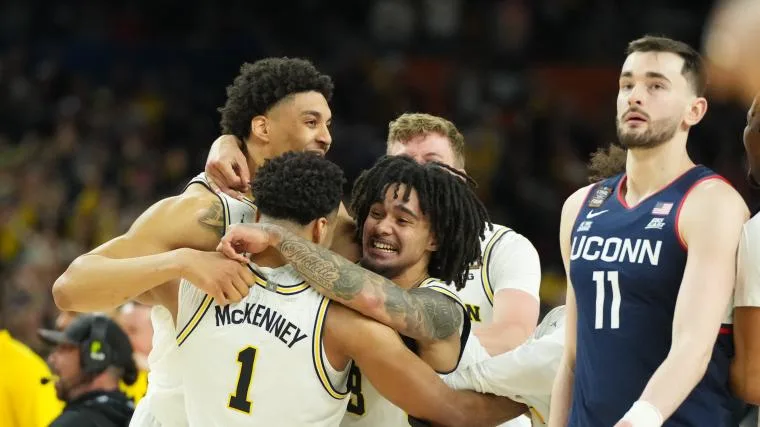
This camaraderie and morale-boost from the Wolverines bolstered Yaxel’s performance in the final minutes of the second half, leading to seven of his total thirteen points being scored in 90 seconds—leading Michigan to the national title for his final college ball game. This demonstration of openness and willingness to lean on others is a beautiful illustration of the power of speaking out about mental challenges as well as the power of prioritizing community within a team.
In a post-game interview, Yaxel stated that “it took a lot to get on the court and stay out there, I was dealing with a lot of mental issues today.” Yaxel is modeling and paving the way for male athletes to be open and honest about the mental roadblocks they face. The mental health challenges of male athletes are represented less statistically compared to females with 31% of male athletes reporting anxiety and depression-related symptoms compared to 48% of females (Moore et al., 2025).
Researchers have been curious if these statistics accurately capture the reality of male college athletes. Many assessment tools used in mental health treatment and research investigate cognitive and emotional symptoms of anxiety and depression, such as racing thoughts or low mood, respectively. But this is not always how men express their struggles. In men, depression and/or anxiety may look more like behavioral changes such as an over-reliance on drugs, alcohol or gambling to numb out and handle the uncomfortable symptoms they are experiencing. With these symptoms flying under the radar in the assessment tools, it is possible that the current statistics are not actually representative of collegiate male athlete’s struggles.
In addition to the possible underrepresentation of men’s mental health concerns, men report being more hesitant to reach out for treatment and support services. The stigma surrounding mental health can threaten a male athlete’s identity of being strong, tough and independent as well as induce feelings of shame and failure. Not to mention the concern of what teammates, coaches or scouts may think of them.
Mental issues in and out of sport are normal; there is no shame in having a tough time, it’s a part of being human. Yaxel embodies candor about the mental toll sport can take. Through leaning on others to get the support he needed to perform with grit and resilience, he displayed mental toughness he may not have been able to reach on his own, and set an example of the power of vulnerability for male athletes.

Mental Illness & Excellence Can Co-Exist
Most Outstanding Player Lauren Betts shows us that mental illness doesn’t stop the creation of a champion.
Lauren Betts was born into sport. As she details in her Players Tribune article, she grew up traveling around Europe as her father played professional basketball (Betts, 2026). Lauren made the USA Women’s Basketball team for the first time at 15 years old and was shortly after ranked number one in the sport. That's when it all caught up with her—the name she had worked so hard to make for herself now felt loaded with pressure to maintain her dominant performance. Fast forward to college—when she started at Stanford, Lauren shared that her inner monologue often reinforced the mantra “if you’re not producing, you’re not worthy” (Betts, 2026).

Transferring to UCLA was a new chapter, a time of making up for the rocky start to her collegiate career. Her work ethic and dedication was coming from a place of fear rather than passion. She pushed her depressive and anxious symptoms down and down until they could no longer be shoved away. As we say in the therapy world, “what you resist, persists.” What we try to ignore tends to only grow stronger in our thoughts, feelings and sensations. For Lauren, it got so bad that one day she woke up and felt like she couldn’t do life anymore. That was when she knew she needed help, and checked into an in-patient mental health treatment center.
The worry and doubt of how her team was doing and what they would think about her when she came back plagued her thoughts. The anxiety of being judged and of letting others down was a heavy thing to carry as she tended to her own needs and survival. But when she returned to practice, she was greeted with nothing but love, care and support. Her teammates were glad to have her back, and were relieved and proud that she took the time and space she needed to take care of herself. Lauren described relief flooding her body when she was welcomed back with so much compassion and understanding.

Lauren Betts is an important icon in sports. She has the platform, she has the talent, and she has chosen to take the vulnerable step of sharing her story. This decision helps all kinds of athletes—from rookies to retired—feel seen, normalizing their own struggles and showing them that they don’t have to carry the pain, the overwhelm or the fear in isolation
Lauren also displays that mental illness does not define who you are, or your potential. As she describes, “the thing about depression that a lot of people don’t talk about is, it never really goes away. You can learn how to manage it really well and find ways to cope.” (Betts, 2026). Handling mental health takes practice, time and support, and every person and athlete deserves to have the tools to take care of themselves on their unique journey.
Benching the Stigma
March Madness has been a pillar of collegiate basketball for decades; it has stood as a standard of excellence and achievement in the sport and has been a momentous occasion for fans to look forward to. For athletes to have the bravery to use this platform to promote mental health awareness, share their personal experiences, and reduce the stigma brings a purpose and power to the tournament.
Mental health in sports has been a consistent topic over the past few years—but change doesn’t happen overnight. It takes many athletes like Yaxel and Lauren to be visible and vulnerable in order to bench the stigma, normalize, and even embrace mental health and performance support in athletics. As the next generation of collegiate athletes rise up, these sports stars have modeled that struggle and success can co-exist, that asking for and receiving help is strength, and that they are not alone on this journey.


References
Betts, L. (2026, March 19). I want to be here: By Lauren Betts. The Players’ Tribune. https://www.theplayerstribune.com/lauren-betts-ncaa-basketball-ucla
Moore, E. M., Simmons, M. A., & Threatt, J. (2025). Mental health challenges and substance use in student-athletes: Prevalence and impact. Frontiers in Sports and Active Living, 7. https://doi.org/10.3389/fspor.2025.1527793
Whelan, B. M., Kliethermes, S. A., Schloredt, K. A., Rao, A., Harmon, K. G., & Petek, B. J. (2024). Suicide in National Collegiate Athletic Association Athletes: A 20-year analysis. British Journal of Sports Medicine, 58(10), 531–537. https://doi.org/10.1136/bjsports-2023-107509


Comments