
Why Therapists Are Obsessed with Alysa Liu

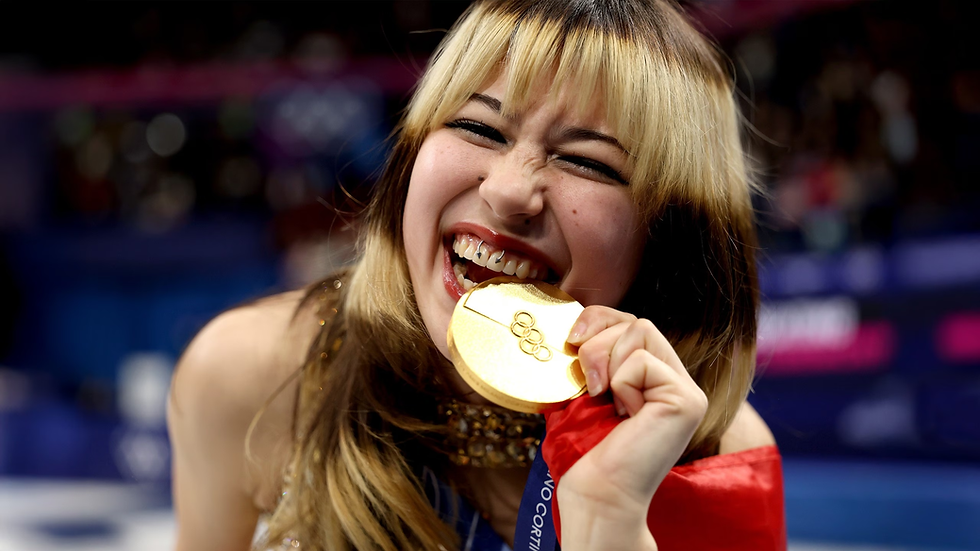
Alysa Liu, a figure skater representing Team U.S.A., has stolen hearts across the internet. She not only ended the 24-year gold medal drought for U.S. women’s figure skating, but did it with halo hair, a facial piercing and a pop song. For those unfamiliar with the sport, this is quite outside the status quo of the traditional appearances and styles that figure skating was built on.
Alysa models that we don’t have to compromise joy, authenticity or lifestyle to achieve at high levels. Her unique approach to sport has captured the attention and analysis of many mental health professionals like myself.
So why are we all so obsessed with Alysa Liu? How has she reached this monumental feat with apparent ease? Let’s dive into it...

Not your average comeback story
How Alysa gained autonomy and agency in a system that thrives on control
The 2026 Olympics wasn’t Alysa’s first rodeo. She finished 6th place in the 2020 Olympics at age 16, and was the youngest U.S. National Champion in history at age 13. Despite this success, she shocked everyone when she retired as a teenager.
As a young figure skater myself at the time, I was shocked—how could someone so young be done already? What wasn’t being publicized was the lack of autonomy Alysa experienced—the diets she was placed on, the skating schedule she didn’t have a say in and the isolation that came with being a champion. Without any agency in her career, there was a lack of motivation, connection and confidence in her skating. Her preferences, opinions and creativity were not being taken into account.
It’s not uncommon for young skaters and other athletes to experience an environment of control and authoritarianism. Young skaters have their schedules, appearances and movements analyzed and dictated down to the smallest detail. Structure is, of course, a necessary and developmentally appropriate component of youth sports. An externally provided structure can serve as scaffolding, supporting athletes to bridge the gap between what they can do alone and what they can do with help. In youth sports, the ability to independently demonstrate accountability, responsibility, and consistency needs to be scaffolded with a high level of external structure first, and slowly titrating autonomy as they develop the skills to be able to handle it.
Unfortunately, the reality of many of these programs is they overlook the opportunity for kids to step into their own agency by maintaining control over athletes beyond the point that it would be developmentally appropriate and supportive. When elite athletes follow their sport to the NCAA or Pro level, all they’ve known is this externally enforced structure. Once these athletes face retirement, they often report feeling lost, lacking time management skills and second guessing their choices. I would guess Alysa felt this way taking a step back from skating—unsure about herself and her next steps. Her journey highlights what can happen when athletes step into their power to harness their vision and their strengths.
The announcement of Alysa’s return to skating wasn’t shocking to the skating community; people return out of retirement but don’t tend to reach the caliber of skating that was in their prime. Unless, of course, they are Alysa Liu, who not only returned but surpassed the quality of skating in the days of her youth. The difference? She was skating on her terms now—she told her coaches she was going to choose her own music and dresses, and that no one would tell her what to eat or how to wear her hair. She made it clear that if these conditions weren’t respected, she would leave the sport again.
This type of agency drives passion, and passion drives high performance. Taking a step back from the sport AND advocating for her autonomy not only was possible but made her an even more competitive skater and well rounded individual. Her prioritization of autonomy led to a deeper connection to the art of skating and gave her an edge. Through this personal stake, consistent motivation in training can naturally blossom; it’s not someone else’s vision she brings to life—it’s her own.
This is the message of empowerment and autonomy that we want to be broadcasting to our youth sports—that they can trust themselves, advocate for themselves and lead fulfilling, intrinsically motivated sports careers that meet their needs and their goals.

What You See Is What You Get
How authenticity is Alysa’s superpower—on and off the ice
Alysa illustrates the textbook definition of authenticity. She does not fit the mold of a typical figure skater, nor does she want to! Alysa exhibits what we call balanced athletic identity—being a figure skater is a part of who she is, but it does not define her. In contrast, “high” athletic identity would consist of seeing herself only as a figure skater and her perception of her worth would be based solely on her athletic performance.
When you highly identify with being an athlete, it can be really hard to show up authentically, because you’re not showing up as a whole person. This can also lead to a host of mental health concerns including depression, anxiety, low self-esteem and identity crisis when faced with injury or retirement. It can be quite easy to fuse athletics into identity without noticing—elite performers spend so much time doing activities related to their craft, they don’t notice the other aspects of their life that are slipping away. Balanced athletic identity allows for bad days and fluke poor performances without compromising an intrinsic sense of self-worth.
Alysa beautifully highlights the importance of nurturing all aspects of your life—she is not only an elite athlete, but a college student, a loyal friend, an adrenaline junkie, a daughter, a social rights activist and an artist. She embraces the authenticity of being a multifaceted, complex, unique person! She refuses to let skating become her whole life and this has given her the space to breathe and to come back to the rink with energy and purpose.
Alysa also prioritizes bringing her style onto the ice—in the music, costuming, movements and choreography of her programs, her personality shines through. She radiates her authenticity without self-doubt or comparison to others or her own past performances. Doubt and comparison are an athlete’s kryptonite, when they creep in, it is common to lose focus and presence in competition. Alysa’s self-trust leaves no room for doubt or comparison to live in her mind or mess with her mental game.

Loving The Struggle But Rejecting The Grind
How Alysa’s mentally tough mindset embraces the process and prevents burnout
On the surface, Alysa Liu seems like a contradiction. She’s on the record saying “I love the struggle; it makes me feel alive," but she has also made it clear that she will not let skating run her life. This combination actually helps Alysa embody what we call a mentally tough mindset. Mental toughness is a hot topic in athletics and can often be misunderstood as synonymous with the “suck it up” mindset. A highly accredited sports psychologist, Dr. Michael Gervais, counters this perception, revealing that “mental wellness is the foundation for sustainable high performance and mental toughness is the bridge between the two.” It is impossible to reach mental toughness if one does not have the foundation of mental wellness.
Alysa’s outlook on her training and her work ethic display the balance and duality of embracing rest to be able to strive, fail and learn, all while enjoying the process.
This perspective is in contrast to typical Western culture, in which we have been accustomed to glorify and adhere to “the grind” mindset—work from dawn to dusk, push through tiredness and make personal sacrifices to expedite success.
Alysa had been through the grind cycle—she basically lived at the rink when she was a child, training on and off ice all day, every day. She didn’t love the struggle then; it was daunting, exhausting and insurmountable. Without the appropriate resources to meet the needs of a high level challenge, mental toughness is eclipsed by low self-efficacy and burnout.
Fast forward to now—she’s embracing mental wellness (physical, mental, social, spiritual rest) to cross the bridge to mental toughness. She knows she has the support and resources to rise to the occasion. She can find joy in the process of becoming, can laugh at the falls and can embrace the struggle that comes with learning and growth through the rejection of the grind ideology.
The constant hustle and grind that is typical in figure skating and other sports (and probably your job) leads to high levels of burnout. In burnout, challenges are not perceived as fun or exciting but as a threat—something to “get through." Burnout can affect us physically, leading to increased risk of overuse injuries, sloppy technique and accidents.
Of course the struggle isn’t going to feel fulfilling or enjoyable if your body and mind are fried and you’re asking it to work at 110%! Rather than hustling around the clock, Alysa recharges her body and mind to show up with the energy and capacity to take on challenging training and a renewed mindset to enjoy the process.
This paradigm shift is not to shirk the responsibility of putting in the time and hard work required for elite performance. What Alysa portrays is that hard work and rest can and MUST co-exist; the balance of giving your all on the ice (or field, or job) and taking the time to recoup can lead to higher levels of success AND enjoyment than hustle culture and burnout could provide. She shows us that when you are regulated and rested, struggle and learning can be fun, meaningful and empowering.

Joy Never Goes Out of Style
How Alysa uses FUN as the antidote to performance anxiety
The most frequent comment I heard about Alysa’s performance throughout her Olympic cycle was in regards to the palpable, exuberant joy that she emitted on the ice. The commentators speculated on how the ice became her playground every time she stepped onto it. By simply watching a few seconds of her program, you could easily tell she was genuinely having a blast.
Play is something that is typically only associated with children, something that as we get older we grow out of. Alysa challenges this, showing the power of play in sport and in daily routine. Play not only encourages positive emotions but also taps into creativity—increasing awareness and integration of personal strengths—and enhances social connection. When we make the time to relax, let loose and play, we are sending signals of safety to our bodies—moving out of our typical rushed and heightened nervous system state.
Perhaps play, joy and presence are the antidote to performance anxiety. When anxiety takes over our bodies and minds, we tighten up, doubt ourselves, lose focus and hyperfixate on outcome. In contrast, when our bodies are at play, we are loose, relaxed, present and actually enjoying the moment and reveling in the process.
Accessing that relaxed, joyful state can be easier said than done. There are a myriad of factors that lead to performance anxiety, and it may not be easy to transition into playful performance from that heightened state. Perceived external pressure and criticism from authority figures, as well as perfectionistic tendencies, are some frequent sources of performance anxiety that may require therapeutic support. While these are valid and challenging hurdles, making the paradigm shift from performance as perfection to performance as play can not only garner the desired results, but also lead to increased enjoyment, self-esteem and empowerment.

She’s a Girl's Girl
How Alysa and Women’s Figure Skating are rewriting the script on what being an elite competitor looks like
In a cutthroat, individualistic culture it is rare to see competitors celebrating one another or lifting each other up. This narrative shifted within the 2026 Olympics. “The Blade Angels” consisted of Amber Glenn, Isabeau Levito (notably, the Jersey girl) and of course Alysa Liu. These teammates exemplified sportsmanship in competition and friendship off the ice—applauding each other, supporting one another in interviews, and encouraging each other throughout training. This is in stark contrast to typical figure skating culture, especially if you were watching in the 90s!
Figure skating is, by nature, an individualistic sport. Unless you are a part of a pairs or ice dance team, it is just you out there on the ice. This means training for yourself, by yourself; which can be an isolating experience. This is another highlighted reason why Alysa quit as a teenager and what may have led her quest for connection in this Olympic cycle.
Although these fierce competitors weren’t together on the ice, their solidarity and celebration of each other could be felt through the TV screen. This is so healing to the young figure skaters that could relate to Alysa’s lonely experience as a kid and teen. It is impeccable modeling to the next generation of skaters watching these elite athletes prioritize community in the face of competition that could tear it apart.
Not only did Alysa befriend her USA peers, she also celebrated the success of skaters across the world. In response to her enthusiastic hugs of Japan's bronze medalist, Ami Nakai, Alysa stated “seeing the people you care about do well… is such an unmatched feeling."
Being an exceptional figure skater used to mean beating your opponents, fueling rivalries and winning at all costs. My hope for the next generation of figure skaters is that the definition of excellence will include grace, support and camaraderie like it was modeled by the ladies of the 2026 Milan-Cortina Games.

The Alysa Liu Mindset—A Balanced and Holistic Role Model In Sports
Alysa has challenged many barriers, stereotypes and norms in figure skating to showcase her art and lead a balanced career on the ice. Alysa highlights what opportunities can happen when we lead from our hearts, let go of pressure, embrace the bravery of being ourselves and advocate for our needs.
As an athlete, coach, and mental health therapist, Alysa’s journey has personally inspired me and left me feeling hopeful and excited for the young athletes who have a role model advocating for mental health and its complexities within sports. Her time off and ravishing return to athletics highlight that you can do whatever you set your mind to, on your own terms—and you don’t have to do it alone.


Comments